Don't wait—get your critical documents and verifications secured today. we provide prompt, reliable Mobile Notarization, Ink-Card Fingerprinting, Certified Apostille, and I-9 Verification services. Proudly serving families and businesses across West Houston, Cypress, Katy and neighboring cities.
Call or text us now: 515-238-6201

The Challenge of Notarizing Estate Planning Documents at Banks
POWER-OF-ATTORNEY, ESTATE PLANNING, WILLS & TRUSTS
Hanh Le
12/14/2025
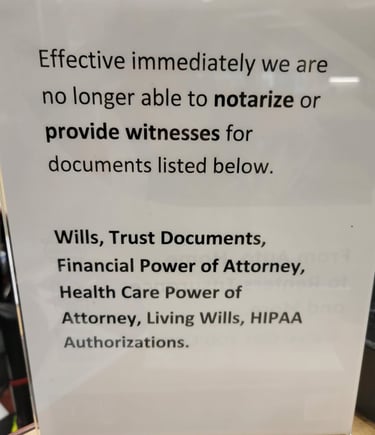
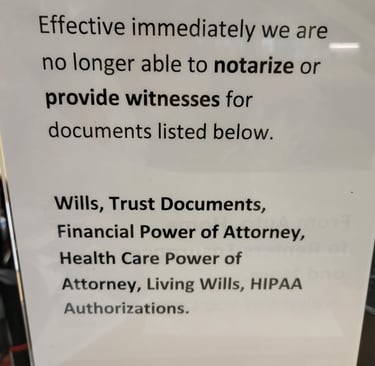
The Challenge of Notarizing Estate Planning Documents at Banks
While many banks offer the convenience of a notary public, they are increasingly unwilling to notarize complex legal documents like a Power of Attorney (POA), Will, Living Trust, or other estate planning paperwork. This isn't due to a lack of a notary on staff, but rather a strategic decision by the bank to mitigate significant risks.
Elevated Legal Liability: Estate planning documents are more prone to being challenged in court than typical banking paperwork. If a bank's notary makes an error in the notarization process, the institution could be pulled into a costly and time-consuming lawsuit. Banks have determined that the risk of legal disputes, particularly regarding claims of forgery, undue influence, or a signer's lack of capacity, outweighs the benefit of providing a free or low-cost service.
Protecting Against Fraud and Elder Abuse: Financial institutions are at the forefront of preventing fraud, especially elder abuse. A Power of Attorney, for example, grants another person significant control over an individual's financial accounts. A bank employee may refuse to notarize if they have any concern that the signer is being coerced, is disoriented, or doesn't fully understand the document they are signing. They may also worry about the "staleness" of an old POA.
Misunderstanding of the Notary's Role: Notaries are not lawyers. Their role is to verify the identity of the signer, ensure the signature is willing, and witness the act of signing. However, estate planning documents often contain language about the signer being "of sound and disposing mind." A bank notary may mistakenly believe this requires them to make a mental or medical assessment, which they are not qualified to do. This confusion often leads to a refusal to notarize, even though their role is simply to follow state-specific notarization laws.
Witness Requirements: Many estate planning documents, particularly Wills, require not only a notary but also two or more disinterested witnesses. Banks are not equipped to provide this service. They may have policies against their employees acting as witnesses due to the added risk, making it impossible to complete the entire signing package in one visit.
The Essential Role of a Mobile Notary
The growing reluctance of banks to handle estate planning documents has created a significant need for a more specialized and convenient solution: the mobile notary. Mobile notaries are independent professionals who travel to the client's location, filling the gap left by traditional institutions.
Convenience and Accessibility: Mobile notaries bring the service directly to the client's home, hospital, or assisted living facility. This is a critical advantage for clients who are elderly, have mobility issues, or are simply too busy to get to a bank during business hours.
Specialized Expertise: Many mobile notaries specialize in loan signings and estate planning documents. They are familiar with the specific requirements for notarizing a Power of Attorney, Will, or Trust, including the proper notarial certificates, witness requirements, and execution processes. This expertise reduces the risk of errors that could render the documents invalid.
Privacy and Comfort: Estate planning is a deeply personal process. A mobile notary allows clients to complete their important legal documents in the privacy and comfort of their own home, which can be particularly reassuring for sensitive or delicate matters.
Coordination of Witnesses: Mobile notaries can often help coordinate the necessary witnesses for the signing, ensuring all parties are present at the same time and place. This simplifies a process that can be a logistical challenge for many families.
In short, while banks have valid reasons for limiting their notary services, the demand for properly notarized estate planning documents has not gone away. Mobile notaries provide a critical, professional, and reliable alternative, ensuring that these vital documents are executed correctly and that the signers' wishes are legally protected.
Need a Notary? Contact ProActive Mobile Notary Today!
For reliable and flexible notary services in Houston and surrounding areas, including Brazoria County, Fort Bend County, Waller County, and Montgomery County, ProActive Mobile Notary is here to assist with your important legal documents.
Why Choose Us?
Convenience: We come to you! Our service is designed to fit your busy schedule.
Wide Service Area: Serving Houston, Katy, Cypress, Richmond, Stafford, Missouri City, Sugar Land, Rosenberg, Fresno, Pearland, Pasadena, and surrounding areas in Harris and Fort Bend Counties.
Contact Us:
Phone: (515) 238-6201
Mobile Service: Schedule a time and place that fits your needs.
Home Office (by appointment): Rolling Creek, Houston, Texas 77084
Hours: 7 days a week, from 9:00 a.m. to 9:00 p.m.
Please remember that I am not a lawyer and cannot provide legal advice.
Legal Notice:
I am not an attorney licensed to practice law in Texas and may not give legal advice or accept fees for legal advice. Under Texas Admin. Code § 87.40, a Notary Public is prohibited from acting as an attorney or preparing legal documents. We are not a government agency; our role in Apostille services is limited to authenticating signatures and providing courier assistance.
ProActive Mobile Notary | Serving Houston & Surrounding Areas Since 2019. We’ve provided expert, affordable mobile notary services across Houston, Katy, Cypress, Richmond, Sugar Land, and throughout Harris and Fort Bend Counties. Whether you need a home visit or an appointment at our home office, we offer flexible scheduling, including after-hours and weekends.
Our Specialized Services:
Legal & Real Estate: Wills, Trusts, Affidavits, Power of Attorney, and Loan Signings.
Specialty Services: FBI Ink Fingerprinting, Apostille/Document Authentication, and I-9 Verification.
Professional Finish: Texas Notary Embosser Seal available upon request.
Thank you for supporting my small business! God Bless America.




Professional Credentials
Hanh Le, owner of ProActive Mobile Notary, is a Commissioned Texas Notary Public and an NNA-Certified Loan Signing Agent. To ensure the highest level of security and professionalism for our clients, Hanh is bonded, insured, and undergoes annual background screenings.
Open 7 Days a week, 9:00 AM – 9:00 PM | Mobile & Home-Office Services (By Appointment Only) | Call or Text: 515-238-6201
Addicks Park Ten | Alief | Barker Cypress | Bellaire | Bridgeland | Brookshire | Cinco Ranch | Copperfield Place | Cypress | Energy Corridor | Fulshear | Galleria | Houston | Hunters Village | Jersey Village | Katy | Meadows Place | Memorial City | Mission Bend | Park Row | Pearland | Pecan Grove | Richmond | Rolling Creek | Stafford | Sugar Land | The Heights | Towne Lake | Westchase | West Houston | 77084 | 77024 | 77041 | 77043 | 77072 | 77077 | 77079 | 77094 | 77041 | 77043 | 77407 | 77429 | 77433 | 77449 | 77450 | 77469 | 77479 | 77494 | 77498 | 77024 | Fort Bend County | Harris County | Montgomery County | Waller County | Notary Near Me | Mobile Notary Near Me